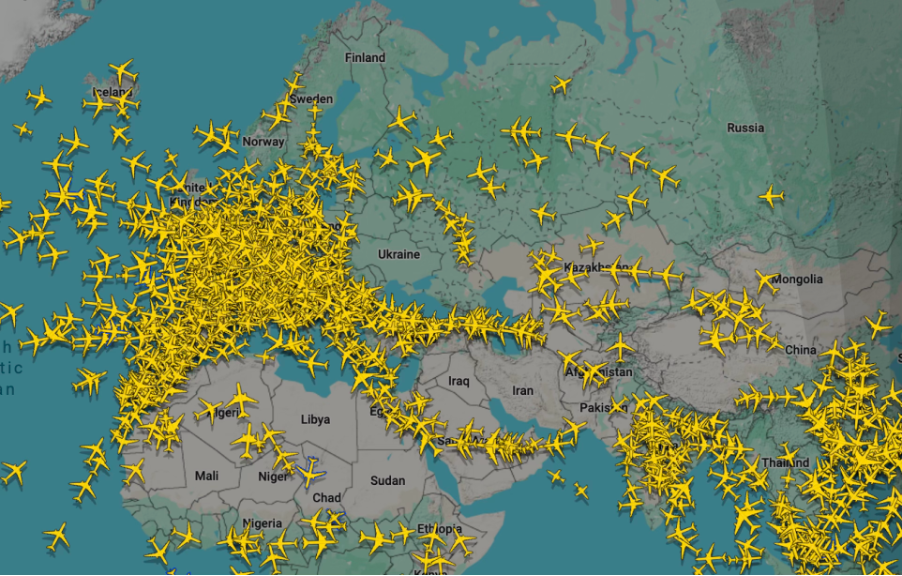
Following a massive military buildup in the region, Israel has persuaded the United States to launch an open conflict with Iran. As always, the side effects are underestimated, and it is easier to start a war than to end one. Nevertheless, we believe the effects are manageable, and that—unlike 30 years ago— it is not oil but AI that currently determines the true focus of the financial markets , alongside key subthemes such as China, defense, and Trump.
On Saturday, President Trump gave the green light for a broad-scale attack on the Iranian regime. In a targeted strike on Sunday morning, the regime’s entire leadership was spectacularly eliminated. But if anyone thought this would lead to a quick regime change, things are turning out differently for now. The regime is a many-headed monster, and for the time being, it is managing to strike back. The plan is clearly to cause chaos in the Gulf States and, in doing so, inflict economic and financial damage on the West. Although the markets are naturally showing considerable nervousness, there is no sign of outright panic for the time being. What is happening, however, is that the Iranian shock is setting off a domino effect in areas where too many investors had flocked—the so-called “crowded trades.” It is also inflicting additional pain on segments of the financial markets that have long been troubled, such as the “private credit” markets. It also comes at a bad time for the European economy, as higher energy prices are putting additional pressure on an already weakened industrial sector. It’s up to us to map out various scenarios and consider how to position—or reposition—our pieces on the financial chessboard.
The best indicator of anxiety about the situation in Iran is, of course, the price of oil. As expected, it has risen sharply due to the bombings in Iran and Tehran’s retaliation. But current prices are not at a dramatic level compared to a few years ago or to historical trends. It makes sense that these prices would spike during a time of stress, but at the moment they seem to point toward a normalization of the oil trade in the foreseeable future. Not only are there (limited) alternatives via pipelines, but there is also the question of whether Iran is capable of posing a permanent threat in the Strait of Hormuz.
Oil Price (Brent) in USD per barrel
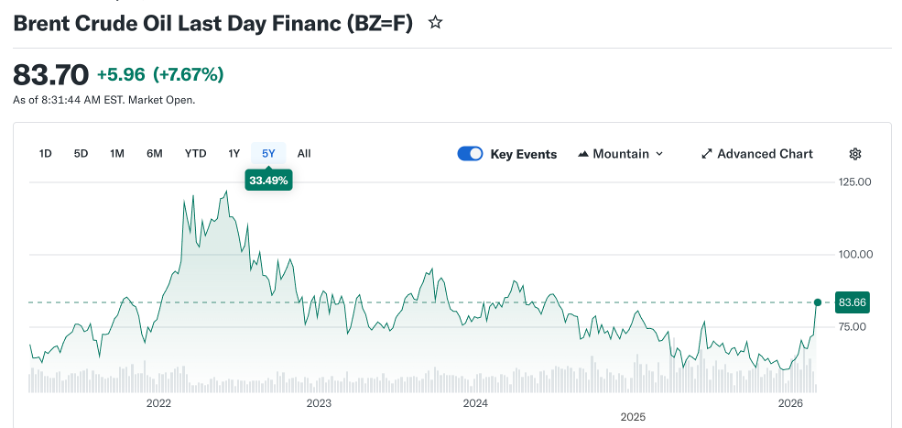
Source: Yahoo Finance, March 3, 2026
Another example of this is the numerous missiles fired at the Gulf States and the relatively limited actual damage (aside from anxiety and disruptions) they caused.
Number of missiles fired by Iran at various Gulf states.
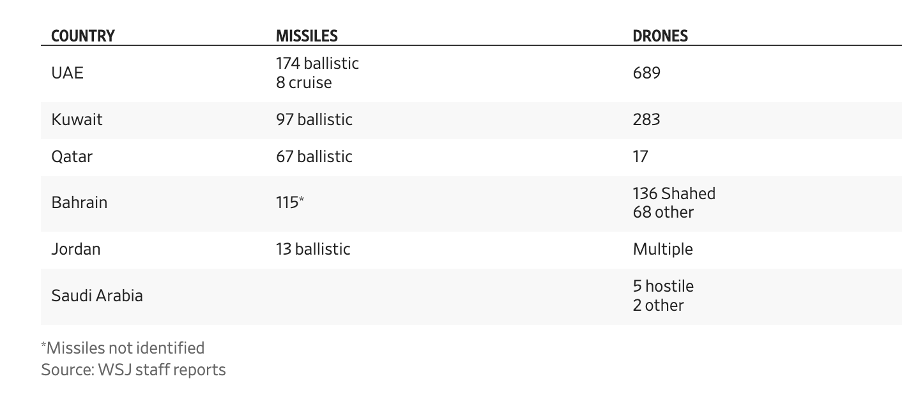
Source: Wall Street Journal, March 3, 2026
The stock markets have gone through a few days of correction, but there is no sign of outright panic there either. The global index is still in positive territory, and in some markets, the correction is more a case of taking profits.
However, you can see that Iran is a “trigger” for correcting existing imbalances in the markets:
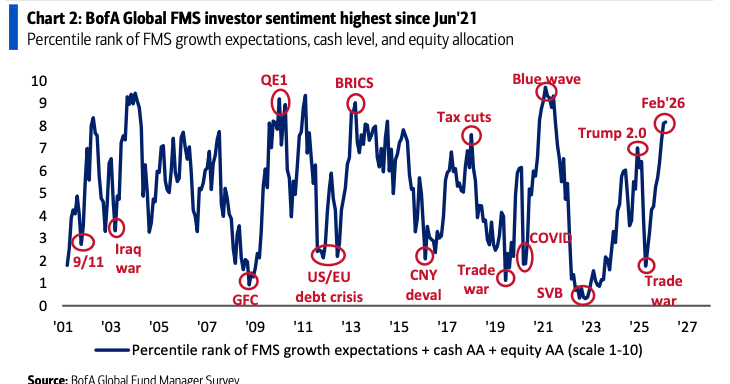
- There was excessive optimism (see graph)
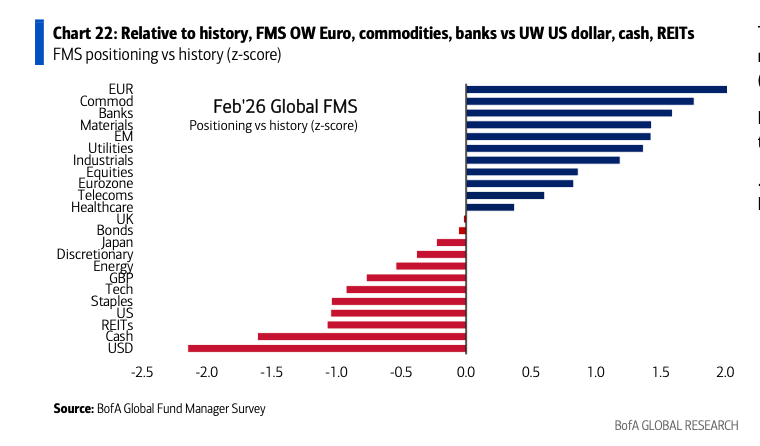
- Investors were largely following the same strategies (“crowded trades”), and those are now correcting. For example: there was widespread optimism about investing more in Europe, avoiding the U.S. dollar, reducing exposure to the Mag7, and buying banks, gold, and commodities. Those sectors are now correcting more sharply. (See the “crowded trades” chart)
Optimize excess
Source: Bank of America
Crowded Trades
Source: Bank of America
Iran will do whatever it can to deal a heavy blow to the West. However, the direct damage caused by airstrikes will be limited. Therefore, Iran will try to find a way to inflict more damage:
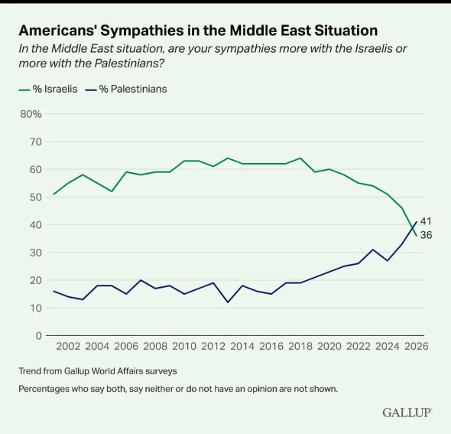
- Financial markets: Uncertainty—and certainly chaos—could lead to a severe correction on Wall Street, for example, which would put the most pressure on President Trump. This war against Iran can count on little support, and the Israelis are receiving less and less sympathy from the American public.
- Oil prices: Oil no longer has the ripple effect it did in the 1970s, but it remains a significant cost, especially when gas prices are factored in. A prolonged conflict could hurt Europe in particular, but also China; the U.S. would be affected relatively less than in the past.
- The reputation and appeal of the Gulf States have been dented, but not shattered. However, prolonged and more “severe” damage could have a greater shock effect, including through financial and economic consequences (just think of the aviation industry).
- Terrorism: Police and counterterrorism agencies in the West are on high alert because they fear that so-called “sleeper cells” will be activated by the Iranian regime to carry out attacks in the West. This certainly cannot be ruled out, and it could cause significant damage to the economy.
There is less sympathy for the Israelis among the American public
Source: Gallup
The Iranian regime will certainly have incorporated this into its strategy and will pursue it to the fullest extent. But there are also counterforces:
- Israel and the United States are superpowers that will always be one step ahead in terms of technology and military might. Iran’s guerrilla tactics can be painful, but with today’s intelligence and precision strikes, they can be quelled more quickly and accurately.
- In this way, Iran is also creating more opponents for itself. The Gulf states are capable of defending themselves and have, all in all, weathered the attacks well. China has no interest in a protracted conflict and will gradually lose patience with Tehran as well. The Iranian people have long been fed up with the regime and are biding their time to show their resistance. Finally, Russia is also being weakened, as the Iranian regime was a major supplier of weapons to fight Ukraine—weapons that Russia will now need for itself.
As mentioned, AI is the focal point of the financial markets in 2026. On the one hand, the market is concerned about the capital intensity of expanding AI infrastructure and how these investments will ever be recouped. On the other hand, it also fears the impact of a successful implementation of AI across the economy, and the risks this poses to established business models, employment, and social stability. In both scenarios, certain expectations (and valuations) will need to be adjusted.
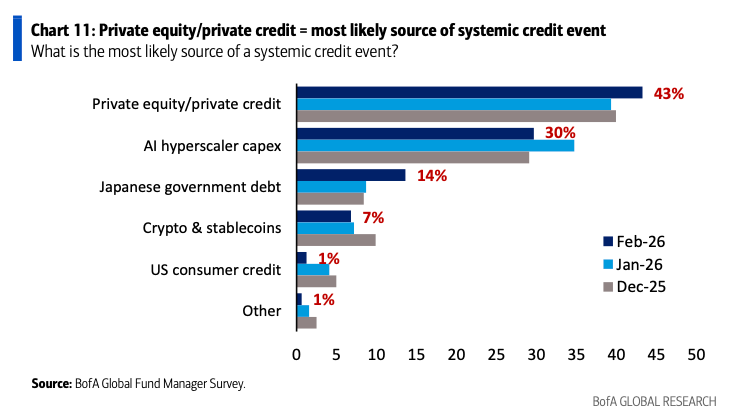
When it comes to the financial domino effect, it’s worth revisiting the Bank of America survey. The survey provides an indication of what institutional investors are concerned about today. The rankings and trends offer a clear indication of where stress lies at the moment: private markets (private credit and private equity), fears of overinvestment in AI, and the broader debt problem in the West. The conflict in the Middle East could further exacerbate this, but the problem exists regardless. On the other hand, these stress points are well-known, and this also means that market participants are adjusting their behavior. Gradually, this could mean the problem becomes less of a systemic threat: Jamie Dimon’s “cockroaches” are no longer a mystery. Banks are reducing their exposure, and risk premiums are rising.
“This is more than just a healthy correction; it is exposing existing weaknesses in the asset class and bringing overblown sentiment and valuations back down to earth. If the conflict does not escalate on a broad scale or become protracted, it will present buying opportunities.”
Geert Noels, CEO & Owner